

Stretcher Bars and Braces: How to Choose and Use Them for a Lasting Canvas
Stretcher Bars and Braces
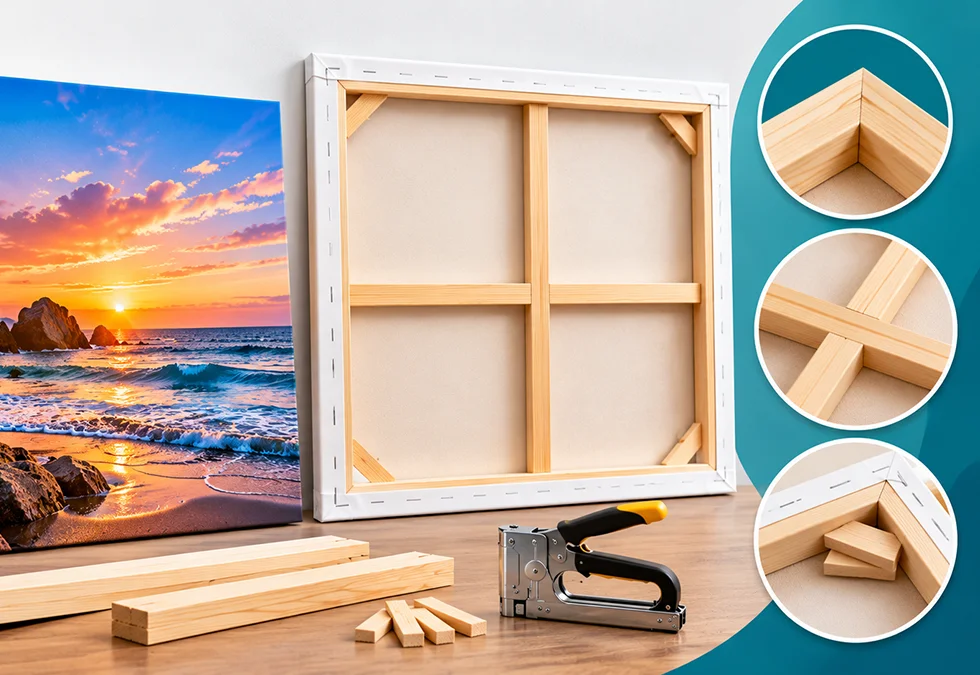
Stretcher bars are wooden or metal bars which form part of the picture frame. The frame (stretcher) is used to ensure that the canvas is both flat and taut. If there was no frame then a canvas would quickly become wrinkled and would not maintain its shape.
Both the type of frame and the way that the canvas is stretched will impact on both the longevity and visual appearance of a piece. Professionally, canvases should be flat and taut. Poorly or incorrectly stretched canvases, despite containing a high quality image, will look old fashioned.
Cross-members are further internal supports for the frame. They are especially important in larger frames as the distance between either side of the frame may be great enough that the frame sags inwards as a result of the canvas’ tension. Whether you are creating your own art or mounting a printed photograph, knowledge of both these components will enable you to more effectively select an appropriate option.
Factors to Consider When Choosing Stretcher Bars
Consider the size and weight of your canvas, then decide on the depth of and whether or not to include a cross brace on your frame. These are key considerations.
Sizing
There are stretcher bars available in a variety of sizes and gauges. You can therefore construct a support of virtually any measurement. Ideally, the bars should be precisely the right size. Combining varying sizes results in an out-of-square support which is difficult to rectify having stretched the canvas. If you'd rather avoid the guesswork, our canvas stretching service takes care of sizing and tension for you.
Material Quality
Standard stretcher bars are an economical option. They will support the majority of smaller and medium sized canvases. Heavy duty bars are constructed from more solid wood so that they can better support large canvases – which in turn can place greater pressure on a frame.
Select wood which is both knot- and kiln-dried. Kiln-drying removes extra water from the wood to help prevent it from warping. Knots are also areas of weakness, and may even cause splits in the canvas.
Bar Depth
Bars can also influence the look of a picture. Bars are commonly between around 3/4 inch and 2 inches in depth. A deeper bar is sturdier and provides a more ‘gallery’ look. However, a thinner bar is appropriate for, and easier to fit into, frames and for smaller works of art.
Corner Joints
Corners are particularly prone to strain. Good joints allow a firm and square fit. They are also able to resist pressure. If corners are badly made then there will be spaces between them which will continue to increase. This results in the canvas becoming less firm.
Cross-Bracing
Cross bracing can also be used. This provides structural reinforcement and stops the bars from bowing. Typically, smaller canvases do not require bracing but larger ones usually do – at least one brace is generally advisable.
Cross Braces
In addition to strengthening the frame, cross bracing can be used to stop warping. Cross bracing ensures that a frame remains firm and also maintains the standard of an artwork. As the frame can sustain tension, it allows for a better, more even and taut canvas.
There are three common types.
- Traditional cross braces are separate wooden or metal pieces that you fit inside the frame after the bars are joined.
- Integrated braces are built into the stretcher bars themselves, so there is nothing extra to fit.
- Keyable cross braces use a key or wedge to lock the brace in place, which gives a firm, adjustable fit.
Each has different benefits. Conventional braces provide the greatest flexibility. Integrated systems are easiest to use and adjustable braces allow the tightness to be finely tuned. The keys are wedge- shaped and slot into the frame. They are generally tapped into position to add extra tension to a canvas which may have become loose.
Applying Stretcher Bars & Braces
Stretching the Canvas
Construct the frame and accurately fit the bars into each corner, ensuring a good tight fit. Place a clean, flat surface and centre the frame over a piece of canvas which has been placed on its base.
Pull the canvas over one side of the frame. Canvas pliers can be used to help hold and stretch the canvas. Push a staple into the middle of this side. Pull the canvas taut over the other side of the frame and push a staple into its middle. Continue to do this for each side. Starting at the middle of each side, gradually pull the canvas towards each corner (alternating between sides to ensure an even level of tension).
Remove any excess canvas from each corner and carefully fold the edges over the frame. Staple these in place. Good quality corners are noticeable in the finished product.
Fitting the Cross Braces
Cut the stretchers to fit within the frame. These can be created in a number of ways – either so that they are parallel to one another (a ladder effect) or so they criss-cross. A criss-cross formation is stronger however and must be shaped with notches in order for them to fit.
Secure the stretchers into position using screws, nails and/or (pre-drilled) pin holes, according to which method is being used. Lastly, ensure that the frame is both taut and fully secured either prior to or after commencement of work.
Note: This is general advice. Each stretching bar system will differ and it is essential that you refer to the guidance relevant to your stretching bars and canvas dimensions.
Custom Stretched Canvas
While there are standard sized canvases, sometimes these are not ideal. Personal canvases can be tailored to the perfect size, whether this is a small work for display on a shelf or an eye-catching large canvas for a focal point.
Again, the correct weight of bar, the required depth and bracing for stability all depend on the canvas size. Correctly specifying these aspects ensures that your canvas remains flat and square for many years.
Should you not wish to construct and stretch your own frame then our Coquitlam based staff can provide this service. We will tailor-make a frame to suit your canvas, stretch it so that the tension is uniform and neatly trim the canvas ready for display.
FAQs: Stretcher Bars and Braces
What are stretcher bars and why does a canvas need them?
Stretcher bars (wooden or metal) are used to create a framework. This is then used to stretch and maintain the canvas. If there were no stretcher bars then the canvas would quickly droop and become wavy and misshapen.
What are the different types of cross braces?
Typical cross braces can be individual metal or wooden cross bars that are inserted in to the framework. Cross braces can also be moulded as part of the stretcher bars. A third option uses a key or wedge to secure keyable cross braces – this allows for a secure and flexible cross brace.
How do I tighten a canvas that has gone loose?
Lightly hammer keys (small wedges) into the framework corners. This causes the corners to widen ever so slightly and thereby re-tensions the canvas. Hammer each corner in turn, ensuring that each is treated equally so that the canvas remains uniformly taut.
How do I stretch a canvas over stretcher bars?
Ensure that the framework is both square and securely assembled. With the canvas positioned upside down, carefully centre the framework. Tense the canvas (using canvas pliers if necessary) and start by stapling the middle of one side. Staple the middle of the opposing side next. Continue in this manner, working towards the corners. Neatly fold in the corners and then staple.
Should I stretch my canvas myself or have it done professionally?
For smaller canvases and where you like to do so, self-stretching is suitable. However, for bigger canvases, as well as for precious art work or photographic prints, it is usually better to have a professional stretch your canvas. This ensures that the canvas is uniformly taut and has neat corners and is immediately ready for display. Our Coquitlam based professionals can stretch canvases to suit both the size and weight of your art work.